In the Z-Wave world, the ground hasn't shaken like this in a long time. After a long while, a new player has appeared, proving that Z-Wave holds a strong position even when everyone is talking about Matter. The Z-Wave protocol has long solved the problems that Matter, as a new protocol, hasn't even begun to address. The portfolio of Z-Wave products is wide, mutual support among controllers is guaranteed, and most importantly, it just works.
This is exactly what Shelly (Allterco Robotics) realized. Until this year, we knew them as one of the most prominent manufacturers of WiFi Smart products. If you are familiar with Shelly products, you certainly know how fast this company advances in terms of development. While other brands offer the same products for years, Shelly has been pushing the boundaries of innovation for several years now.
How Shelly entered the Z-Wave world
Many of you have encountered Qubino products in the past. To this day, the most popular energy metering device with the Z-Wave protocol is the Qubino 3-Phase Smart Meter. Their portfolio also included relays and dimmers. Shelly chose to enter the Z-Wave world precisely through the acquisition of Qubino. This means that Qubino as a standalone company ceased to exist, and Shelly took over the product development.
It was very interesting to watch how this transition took place. Shelly didn't start selling products based on the platform Qubino had built, but rather on its own platform. Today, we witness Shelly selling relays that look identical in detail to their WiFi relays, but with a built-in Z-Wave 800 chip. The first series even came out under the name Shelly Qubino Wave. Let's wait and see how long the name Qubino will remain part of this portfolio.

Shelly Standard Wave Modules
Right after announcing its entry into the Z-Wave ecosystem, Shelly introduced a novelty in the form of several "standard" products. I intentionally put the word standard in quotes, because the standard mainly refers to design and size. That's exactly how we can describe the basic series of Shelly Wave products, which includes:
- Shelly Qubino Wave 1 - 1-output module with a 16A dry contact relay
- Shelly Qubino Wave 1PM - 1-output module with a 16A relay and power metering
- Shelly Qubino Wave 2PM - 2-output module with 2x10A relays and power metering
- Shelly Qubino Wave Shutter - Module for controlling blinds, roller shutters, and other shading devices.
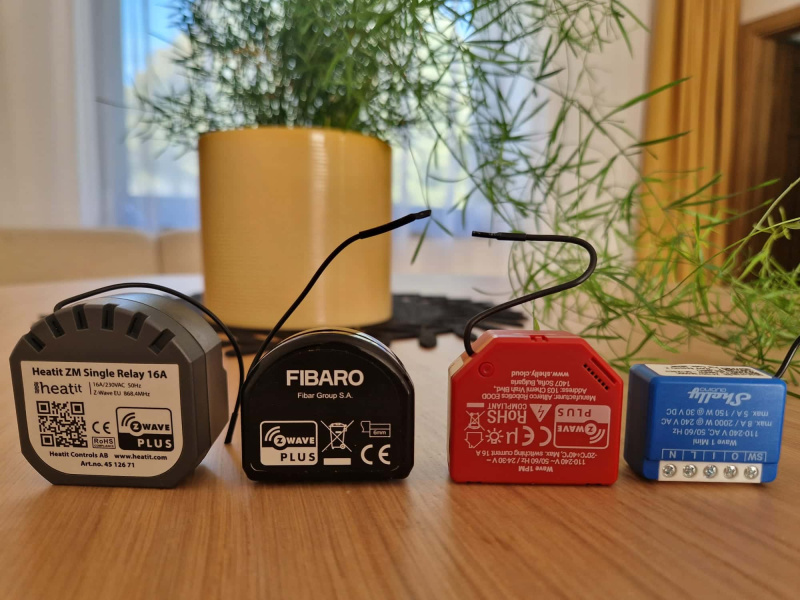
These modules are very similar to those we already had in our offer, including modules from FIBARO, Aeotec, or Qubino itself. Their advantage lies in the fact that they contain the latest and best technology currently available. Regarding the Z-Wave chip, these devices feature the latest generation in the form of Z-Wave 800. With FIBARO devices, we mostly still encounter the older Z-Wave 500 chip. Moreover, Shelly managed to fit a 16A relay into a standard-sized device. This means that you can place the Shelly Qubino Wave 1 and Wave 1PM directly behind an electrical outlet, as they have a relay powerful enough to match the standard outlet breakers.

Later, two more specialties were added to the lineup of standard-designed modules. These are products that no other manufacturer had brought to the market until now, even though the very principle of Z-Wave practically demanded them. They are modules without any outputs, meaning they can't control a physical load, but you can install them behind a regular wall switch to control other Z-Wave devices via inputs. They basically allow you to create a "remote controller" in the design of a standard wall switch. These elements are:
- Shelly Qubino Wave i4 - device featuring 4 switch inputs, powered by 230VAC
- Shelly Qubino Wave i4 DC - Version with 4 inputs and 24VDC power supply.
These devices work perfectly with Z-Wave associations, meaning that controlling other Z-Wave products is possible even without a central hub, but they can also serve as scene activators.

Shelly Wave MINI Modules
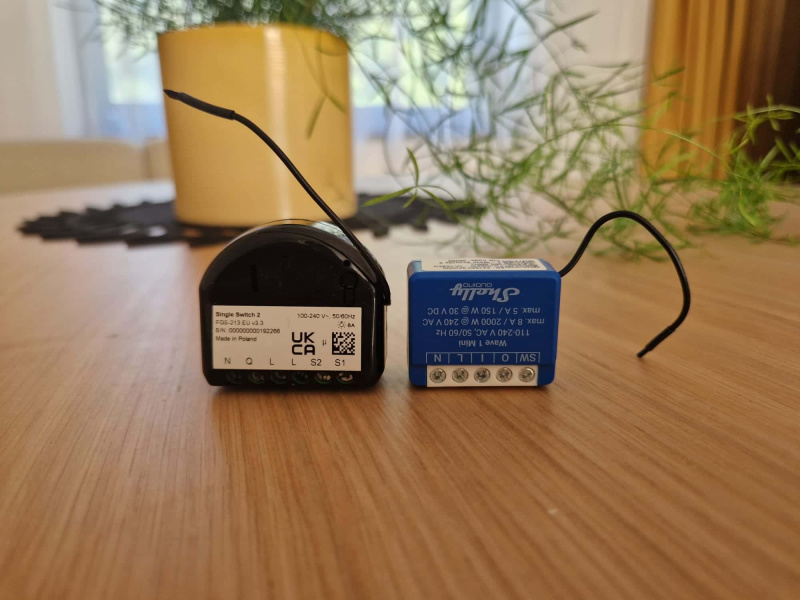
Shelly subsequently brought to its portfolio what we have long been waiting for. The Shelly Mini modules, which already caused a hype in the WiFi Smart Home sector, entered the market with the Z-Wave 800 protocol. Even though they are fundamentally still relays, this is a true breakthrough in the lineup. Shelly Mini modules offer very similar technical specifications to competing products but in significantly smaller dimensions. The main point is that despite the module being much smaller, it still houses an 8A relay, just like standard modules from brands like FIBARO. The second major advantage is the integration of the Z-Wave 800 chip, which is the latest the Z-Wave Alliance currently offers.

The range of Shelly Mini modules is currently limited to 3 products. Unless Shelly breaks the limits again, it will probably stay that way, mostly due to technical constraints. For instance, creating such a small module for dimming would require developing an entirely new dimming component, as the ones used on the market today barely fit into standard-sized modules. However, these currently available devices can already greatly simplify Smart Home installations. The Mini lineup includes:
- Shelly Qubino Wave 1 Mini - A truly mini relay with Z-Wave 800 and a 1x8A dry contact output
- Shelly Qubino Wave 1PM Mini - Very small relay with Z-Wave 800 and 1x8A output with power metering
- Shelly Qubino Wave PM Mini - A power metering-only module, without switching capability, in a mini format.
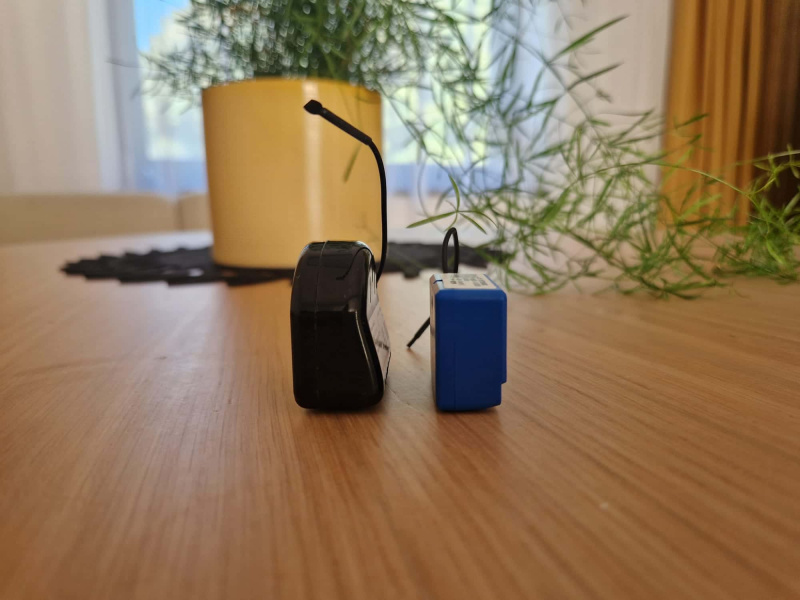
As you can see, the specifications of these modules are truly fantastic. Without compromising on established standards, Shelly simply managed to create modules that clearly win by size. And this win is not just by a few millimeters, as we were used to in previous size battles. The difference here is huge.

Shelly Wave PRO Modules
It's hard to believe that a company which just entered the Z-Wave world already has a third series of products ready. That's right, Shelly also introduced a portfolio of PRO modules, which, as the name suggests, are designed for professional installations. This time, it involves installing directly into the distribution board (electrical panel), which obviously requires preparation during the electrical wiring phase. These modules allow for an installation where you always have access to all devices without needing to dismantle wall switches. Naturally, the price for this is a star-wired electrical installation.
The Shelly Wave PRO lineup includes:
- Shelly Qubino Wave PRO 1 - DIN rail module with Z-Wave 800 and 1x16A dry contact output
- Shelly Qubino Wave PRO 1PM - DIN module with 1x16A output and power metering
- Shelly Qubino Wave PRO 2 - DIN module with 2x16A dry contact outputs
- Shelly Qubino Wave PRO 2PM - DIN rail module with 2x16A relays and power metering
- Shelly Qubino Wave PRO 3 - Up to 3x16A with dry contact outputs
- Shelly Qubino Wave PRO Shutter - Control of blinds or roller shutters directly from the DIN rail.

Furthermore, all Wave PRO modules also feature inputs for wall switches. This means that with correct wiring, your lighting and blinds will still work via physical switches even in the event of a smart home hub failure. A second option, if you don't have switch cables pulled all the way to the distribution board, is to use the aforementioned Shelly Wave i4 to create smart switches.
| Shelly Wave 1 Mini | Shelly Wave 1PM Mini | Shelly Wave 1 | Shelly Wave 1PM | FIBARO Smart Module | Fibaro Switch Gen5 | HeatIT ZM-Relay | |
| Protocol | Z-Wave 800 | Z-Wave 800 | Z-Wave 800 | Z-Wave 800 | Z-Wave 500 | Z-Wave 500 | Z-Wave 700 |
| Power | 8A | 8A | 16A | 16A | 6.5A | 8A | 16A |
| Size | Mini | Mini | Standard | Standard | Standard | Standard | Large |
| Power Metering | No | Yes | No | Yes | No | Yes | Yes |
| MSRP | €23.88 | €26.28 | €27.90 | €29.90 | €78.99 | €78.99 | €52.80 |
Shelly's pricing policy is truly very customer-oriented. In some cases, a single module costs a third of what a competitor's module costs. Of course, these are recommended retail prices, which might not always reflect the real market, and discounts apply, but these base prices are where those discounts start.
When installing an entire Z-Wave Smart Home, the price difference is so significant that it shifts a Z-Wave-based system from the thousands of euros range to the hundreds of euros range. Considering the advantages this protocol offers over WiFi, it's a truly excellent value proposition.
Where will you feel the size difference?
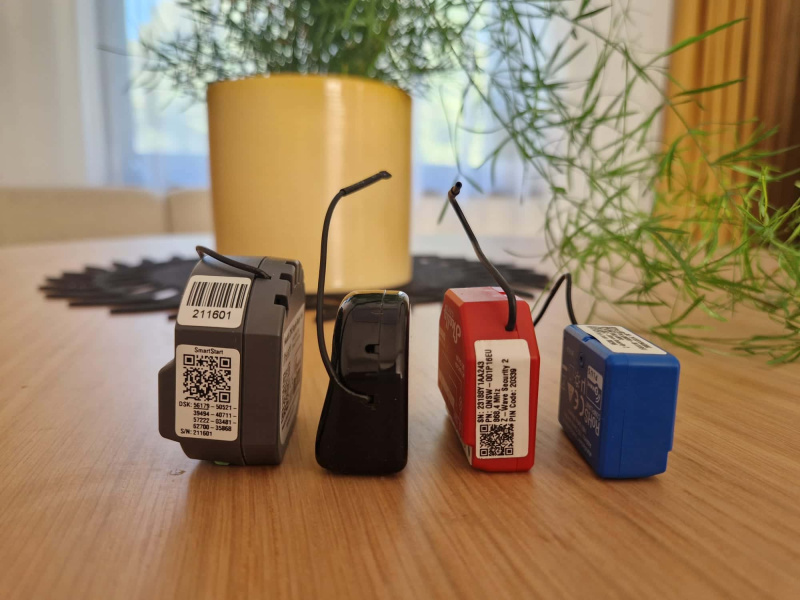
Of course, size doesn't always matter :) However, when installing modules behind wall switches, size is absolutely crucial. While you can fit most modules into a standard 6cm deep installation box, if it's a junction box with many cables, fitting the physical switch back can be a struggle. And this is exactly the biggest advantage of Shelly Mini Wave modules. Ultimately, judge for yourself how much more room for maneuvering is left in the boxes:
 |
 |
What is missing in the Shelly Wave lineup?
It is clear that the offering from a manufacturer who has been on the market for such a short time cannot be fully complete yet. However, it can be expected that Shelly will complement most of the missing modules within a few months, as they already offer them in their WiFi versions. For now, however, the following are not available in Z-Wave:
- RGBW Module - can be substituted with the FIBARO RGBW module
- Dimmer Module - can be substituted with the FIBARO Dimmer
- Thermostat and Radiator Valve - can be substituted with any Z-Wave thermostat or radiator valve
- Universal Sensor - can be substituted with the FIBARO Smart Implant
- Sensors - These form a massive part of a Smart Home, and Shelly doesn't have them in the Z-Wave lineup yet. However, there are alternatives for everything.
- Shelly Hub/Controller - A proprietary system where Shelly Z-Wave products could be operated fully locally.
Here, the core advantage of Z-Wave shows up again, as this protocol makes it incredibly easy to combine products from multiple manufacturers into one unified system. So even though these products are missing from Shelly's lineup, they can be easily replaced by others.
When to opt for other brands?
It might look like we could just throw out all other manufacturers from our catalog and start selling only Shelly Wave. To a certain extent, that's true. However, there are situations where using products from other manufacturers makes more sense. Here are a few examples:
- If having seamlessly integrated modules is critical for you, it is better to use FIBARO modules in a FIBARO system. It's not a huge difference, but there is some.
- If you specifically need a certain parameter, such as a frequently used "Auto Off" timer, some modules might not support it.
- If you prefer a 5-output module for a cleaner installation, the Heltun Quinto is an excellent solution.
- If you need a module that perfectly communicates with, for instance, a HeatIT Z-Temp thermostat via associations, the HeatIT relay is a better choice.
The biggest downside at the moment is that Shelly does not offer its own controller/hub for this protocol. Therefore, it relies on systems provided by other manufacturers like FIBARO, Homey, SmartThings, Hubitat, or Home Assistant. There is no need to blame them for this, as the Z-Wave standard was specifically created for interoperability. However, it is obvious that a manufacturer like FIBARO will somewhat favor their own modules in their system, even if it's just minor things like cleaner setting menus, direct mobile app inclusions with images, and the like. These are rarely major differences, but they are worth mentioning.
Shelly actually has a powerful Smart Home platform that they use for their WiFi/LAN and Bluetooth products. In my opinion, it is only a matter of time before they release hardware that will run this system locally and support their own Z-Wave devices. What is absolutely clear, though, is that Shelly has made a massive impact on the Z-Wave market, and it looks like this is just the beginning.