
How to wire a thermostat for underfloor heating?
When building a new home or renovating an old one, an increasing number of people are choosing underfloor heating systems. It’s no wonder, as it brings a multitude of benefits to any household. However, to maintain the optimal temperature, investing in a high-quality thermostat is absolutely essential.

When installing underfloor heating, make sure to choose the right thermostat.
Which underfloor heating thermostat is the best?
First and foremost, it is important to know what a thermostat actually does. This small device is the heart of your heating system and can control boilers, heat pumps, electric underfloor heating, traditional radiators, or solid fuel boilers.
The main purpose of a thermostat is to regulate the room temperature. There are several types available on the market. Here is a basic breakdown:
- Mechanical – do not require an external power source. An example is the thermostatic valve on a radiator, which works based on the expansion of liquids and gases.
- Electrical – devices connected to the power grid or running on batteries. This category is further divided into digital and analog thermostats.
- Digital – sense and regulate heat while displaying real-time data on a screen. Users highly appreciate their advanced features that ensure significantly better comfort.
- Analog – older models working on a bimetallic strip principle. Today, they are mostly replaced by digital ones, as their only function is basic temperature regulation.
How does an underfloor heating thermostat work?
A high-quality underfloor heating system is capable of heating efficiently and regulating the temperature to achieve maximum energy efficiency.
The principle of regulation relies on opening and closing the valves on the heating manifold. The heating system sends a signal to the thermostat whenever there is a change in the room’s temperature.
For the most efficient heating, the ideal solution is zoned heating, which allows you to set different temperatures in specific rooms at different times. For instance, a bedroom should have a lower temperature in the evening (15–19 °C) for better sleep, while a bathroom requires a higher temperature. Once the room reaches the desired temperature, the thermostat stops the heating cycle.
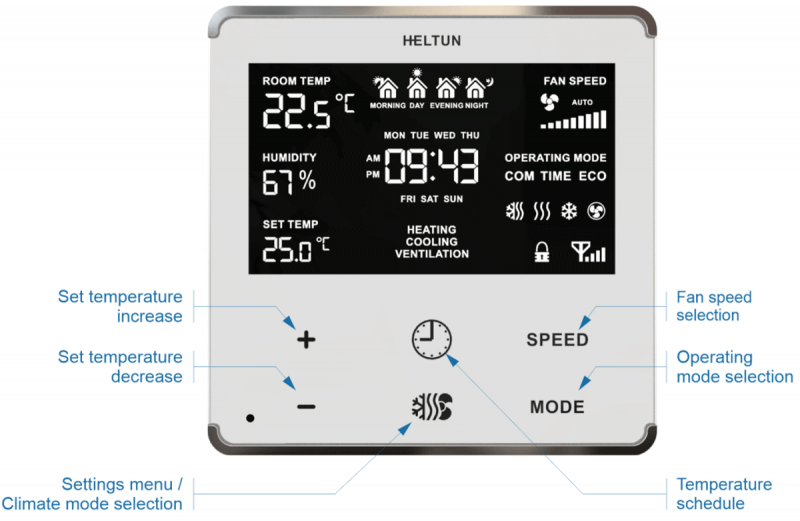
Smart FanCoil thermostat for heating and cooling control.
Which electric underfloor heating thermostat to choose and how to wire it?
In short, a thermostat for electric underfloor heating is wired directly to the electric heating cables in the floor, which typically have a power output ranging from 2300 W to 3680 W. If your heating system exceeds this wattage, you must connect the load terminals via an external contactor (relay).
Next, you need to connect the external floor temperature sensor, which is placed inside an installation tube directly beneath the floor covering. When installing, keep in mind that the closer the sensor is to the surface of the floor, the more accurate the reading will be.
Also, ensure proper spacing. There should be a minimum distance of 3 centimeters between the tip of the sensor and the heating cable. Avoid placing the sensor in the same tube as other high-voltage power cables to prevent signal interference.
Underfloor heating thermostats are powered directly from the 230V mains. Don't be intimidated by the wiring—these devices feature clearly marked terminals. One set connects to the external floor sensor, the second to the heating cable (or contactor), and the third to the 230V power supply.
Electric underfloor heating – control
Precise heating control is guaranteed by a floor probe that constantly monitors the actual temperature of the floor. Based on this data, the thermostat maintains your set temperature while preventing the floor from overheating. You can configure temperature limits directly on the thermostat or via a central Smart Home hub. You can read more about how to regulate underfloor heating in the sections below.
Setting up an underfloor heating thermostat: Fast, easy, and smart
Wiring an underfloor heating thermostat is something you can easily manage. When purchasing a smart thermostat from us, you will receive a practical and clear manual for a hassle-free installation. Should you need any assistance, our technical support is ready to help. The following instructional video might also be highly useful.
MCO Home thermostat for underfloor heating control.
Underfloor heating control via a smart thermostat
In the past, there was a misconception that the heat output of an underfloor heating system could not be flexibly adjusted. Modern technologies have completely busted this myth. You can have your system under constant control thanks to smart thermostats, which offer a multitude of intelligent features compared to basic models.
These features include cooling control, adjusting heating curves based on outdoor weather, and precise time schedules. A smart thermostat automatically ensures maximum home comfort.
If you feel chilly while relaxing on the couch in the evening, you no longer need to get up to adjust the temperature manually. All you need is your smartphone and a Wi-Fi connection. Wireless and highly flexible control is something anyone who has tried a Smart Home will deeply appreciate.

Smart thermostats will significantly boost your home comfort.
How to regulate underfloor heating for maximum comfort?
To maintain a healthy and cozy home, apart from natural light, air quality and stable temperature are vital. Therefore, understanding the correct setup for your heat regulation is crucial.
Useful tip: Underfloor heating is ideal for new builds and renovated homes with high-quality thermal insulation. In poorly insulated buildings with significant heat loss, the heating will not be fully effective, as the maximum allowable floor surface temperature is limited (approx. 29 °C) for health and technical reasons.
Also, consider how often the property is used (e.g., a weekend cabin), because an underfloor system takes slightly longer to heat up the space from a completely cold state.
Compared to traditional radiators, underfloor heating offers these advantages:
- ensures an even distribution of heat across the entire room,
- is easily and precisely controlled via a smart thermostat,
- prevents dust circulation, creating an ideal environment for allergy and asthma sufferers,
- does not dry out the air, helping to maintain natural humidity,
- saves interior space by eliminating wall-mounted radiators,
- reduces energy bills due to lower heating water temperatures,
- retains heat for much longer thanks to the floor’s thermal mass,
- is practically maintenance-free.
Need help choosing and wiring a smart thermostat? The experts at Home System are happy to assist you. Do not hesitate to contact us!